
Does Melatonin Work for Sleep? What the Evidence Actually Says
12th Jun 2026
Melatonin is the hormone that governs your body clock. It's become one of the most popular sleep supplements in the world, yet the leading sleep medicine body suggests against using it for chronic insomnia.1
It is also widely misunderstood, and most people take far more of it than their body would ever make on its own. Let’s unpack what the clinical evidence says – and why less is more.
The problem with melatonin supplementation
Here’s the uncomfortable part. Most people take melatonin at doses far exceeding what their own body produces, at the wrong time of night, for a sleep problem melatonin was never designed to solve. The result is not better sleep. Often it is groggier mornings and a habit that does little.
This matters whether you are a busy professional protecting cognitive output across a long week or someone in your fifties who simply wants to wake up clear-headed again. The biology is the same. So is the fix.
Your body already makes melatonin
Every evening, as light fades, a small gland at the base of your brain – the pineal gland – begins releasing the hormone into your bloodstream. It’s a signal, not a sedative, telling the brain that night has arrived and that the conditions for sleep are in place.2
A clock signal, not a sleep switch
That distinction is the whole story. Melatonin sets the timing of sleep. It doesn’t force sleep the way a sedative does. Think of it less like an off switch and more like a sunset. It sets the conditions for sleep without forcing it.
Most sleep difficulties aren’t caused by a broken sunset signal. They have other roots, and melatonin doesn’t address them. A timing cue cannot fix a stress response.
This is also why melatonin deserves more respect than the supplement aisle suggests. It is a hormone with real effects on the body's internal clock (circadian system) and beyond.
Supplement or medicine? It’s complicated
Several countries regulate it as a medicine. In the UK and Australia it is typically prescription or pharmacist-controlled, and some markets sell only low doses over the counter while higher doses require a prescription.
In Singapore and the United States, it is available freely as a supplement, which makes informed dosing your responsibility rather than a pharmacist’s. In Singapore, however, prescription-grade melatonin (such as Circadin) requires a doctor’s prescription.
So the real question is not whether melatonin is natural. It is whether you’re using it the way the biology actually works.
Most people are taking far too much melatonin
In our increasingly sleep-deprived world, melatonin supplementation has become enormously popular. In a 19-year study, use among US adults rose roughly fivefold between 1999 and 2018, from about 0.4 percent to 2.1 percent of the population.3
The logic feels obvious: your body produces it naturally, so taking more of it should help you sleep, right? Not so. That reasoning leads most people straight into a dosing problem that makes things worse, not better.
And, over the same period, the American Academy of Sleep Medicine (AASM) reviewed the clinical data and suggested that clinicians not use melatonin for sleep onset or sleep maintenance insomnia in adults.1 This is not a strong prohibition, but the direction is clear. The most popular sleep supplement in the world is one the main sleep medicine body advises against for the problem most people are using it for.
The dosage problem
Your body's natural night-time melatonin signal is tiny, far smaller than what is in a typical supplement. Most supplements on the shelf contain 3 to 10 mg.
That gap matters. When you take far more melatonin than your body would ever make on its own, the level in your blood shoots well past its normal night-time range. At that point melatonin stops acting as a gentle signal that it's time to sleep and starts acting more like a blunt sedative, simply making you feel drowsy.
A review of how melatonin works in the body draws exactly this line: a dose that matches your normal night-time peak works with your biology, while a much larger dose does not.2
The drowsiness is real. So are the trade-offs. As the Sleep Foundation notes, doses above 2 to 3 mg are unlikely to work better than 1 mg or less, but do increase the risk of side effects.
- Higher doses have not been shown to improve sleep quality. A meta-analysis of 26 clinical trials found that melatonin’s sleep-promoting effect peaks at around 4 mg, with no additional benefit at higher doses.4
- It can leave you groggy and mentally foggy the next morning, the opposite of the clear start most people are after.2
- There is also a theoretical concern that consistently high doses could, over time, blunt the body’s own responsiveness to melatonin, though this has not been confirmed in human studies
There’s a second problem: the label may not reflect what is in the bottle.
A study in the Journal of Clinical Sleep Medicine found that measured melatonin content across 31 commercial supplements ranged from 83% below to 478% above the stated dose – with variation of up to 465% between different batches of the same product. Some products also contained serotonin, a related compound that should not be there.5
In other words, even people trying to dose carefully often cannot, because the number on the label is unreliable.
Where melatonin genuinely earns its place
Melatonin works best when the body clock itself is the problem:
- Jet lag: timed correctly, a low dose helps reset the clock to a new time zone
- Shift work: when sleep and wake times are repeatedly out of sync with the body's natural rhythm
- Delayed sleep phase: when the clock sits consistently several hours later than you want it to
In each case the problem is a misaligned clock, and melatonin is the right tool for the job.6 This is also how clinicians use it. For circadian problems, sleep specialists at Johns Hopkins advise 1 to 3 mg taken about two hours before bed, not at bedtime. The aim is to reinforce the body's existing timing signal, not to overwhelm it.
Why sleep is foundational, not optional
Sleep is one of the foundations on which your Biological Capital (Biocap) is built. Your capacity to think clearly, recover, and perform across a decade is not fixed. It compounds when you manage it and erodes when you do not.
Deep sleep is the body's maintenance window. It is when the body and brain do much of their repair and housekeeping: tissues recover, the brain clears out the by-products of a day's activity, and the day's experiences are sorted and stored as memory.
Lose those stages night after night and you are not simply tired. You are drawing down an asset that becomes harder to rebuild with age.
Protecting sleep quality is one of the highest-return decisions you can make for long-term cognitive and physical capacity, which is precisely why over-sedating it with a high-dose hormone is the wrong trade.
A smarter approach to better sleep
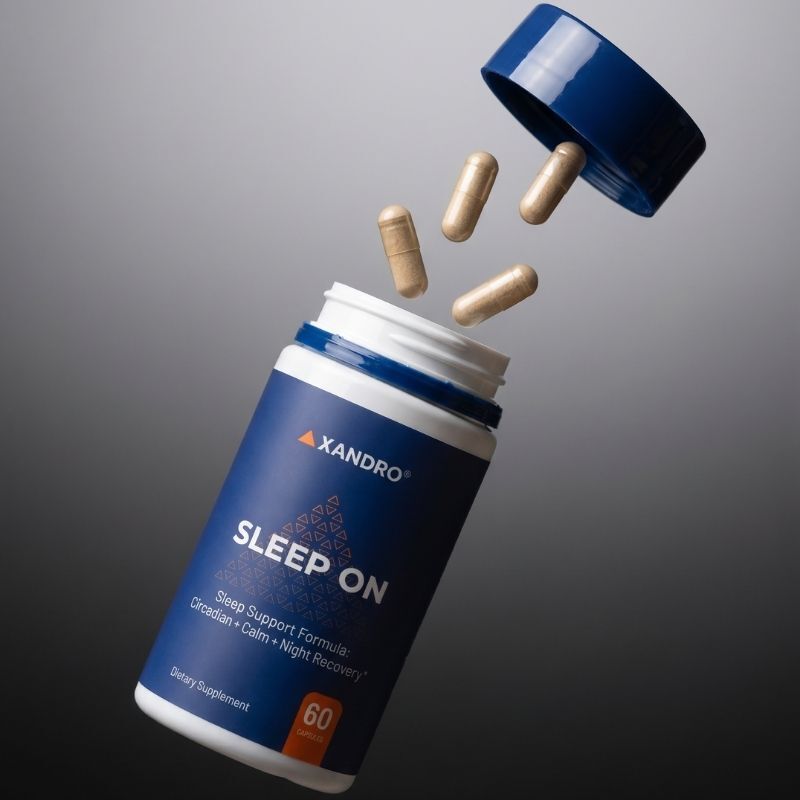
Our new sleep-support protocol Sleep On takes a different route. It uses 1 mg of melatonin from Melostacio™, an extract of pistachio (Pistacia vera). At this level the goal is to reinforce the body's own signal rather than override it.
The plant-derived format may matter, for a specific reason. A laboratory study found that pistachio extract is naturally rich in melatonin and also contains a second compound that seemed to strengthen melatonin's effect where it docks in the brain.7 In other words, the whole plant extract appears to do something that melatonin on its own does not.
How Sleep On targets 3 sleep pathways
Melatonin – even at the right dose – only addresses the timing part of the sleep problem. The stress response, the alert nervous system, and the cortisol that peaks when it should be falling all need different support.
That’s what the rest of the Sleep On formula addresses. Three ingredients, each working on a different piece of the problem:
- Melostacio™ (1 mg phytomelatonin) – reinforces the body’s existing sleep timing signal at a dose the body was designed to respond to. In a randomized, double-blind, placebo-controlled trial, supplementation was associated with reduced insomnia scores and lower serum cortisol, and improved vitality.8
- Holixer® Holy Basil – a clinically studied adaptogenic plant extract. An 8-week randomized, double-blind, placebo-controlled trial of this extract (dosed at 125 mg twice daily) found greater improvements in perceived stress and insomnia scores, and lower hair cortisol at week 8, and it was well tolerated.9
- GABA – the brain's primary quieting signal. A human trial found that 100 mg shortened the time taken to fall asleep.10 A separate 90-day trial in sedentary women with overweight who were following a structured exercise programme observed trends toward improved sleep and calmer nervous-system activity with 200 mg daily, though the study was small and further research is needed.11
None of it is sedation. All of it is working with your biology rather than against it.
How to use melatonin sensibly
If you are reaching for melatonin, a few practical points follow directly from the evidence above:
- Match the dose to the job. For circadian issues, 1 to 3 mg is the range clinicians use. More is not better, and high doses tend to trade morning clarity for night-time drowsiness.
- Mind the timing. For jet lag or a shifted clock, take it about two hours before your target bedtime, not as you get into bed.
- Read the label carefully. Because content varies so widely between products, choose supplements that are third-party tested and made to a quality standard you can verify.
- Be honest about the problem. If your sleep is broken by stress, a racing mind, or late-peaking cortisol rather than a misaligned clock, melatonin alone is unlikely to be the answer. Address what is actually keeping you awake.
The short version
Most people use melatonin at the wrong dose, at the wrong time, for the wrong kind of sleep problem. At 5 mg at bedtime it is no longer really acting as a timing signal. It is acting as a mild sedative,2 and one the main sleep medicine body does not recommend for insomnia.
The right dose is lower. The right timing is earlier. And for most modern sleep difficulty, the answer is to address what is actually keeping you awake, which is rarely a shortage of melatonin. Protecting sleep is one of the foundations of building biological capital, so it is worth getting right.
Also in this series
→ The three biological reasons you can’t switch off – and why most sleep aids fall short
→ Why Sleep Quality Matters More Than Sleep Duration – The Science of Non-REM Sleep
→ Why Your Cortisol Is Highest When You Most Need to Sleep
→ Magnesium Glycinate vs Ashwagandha vs Sleep On – Which Sleep Supplement Is Right for You?
Frequently asked questions
Does melatonin actually work for sleep?
For circadian problems such as jet lag, shift work, and delayed sleep phase, yes, at a low dose and the right timing. For everyday insomnia driven by stress and an overactive mind, the clinical guidelines are not supportive, because melatonin addresses timing rather than the stress response that is usually the real cause.
What is the right dose of melatonin?
Lower than most people think. The body's own night-time signal is very small, and clinicians typically use 1 to 3 mg for circadian issues. Common 5 to 10 mg doses push levels far past what the body makes, which tends to cause grogginess rather than better sleep.
Is plant-based melatonin better than synthetic?
They deliver the same molecule. The interest in pistachio-derived melatonin comes from early laboratory work suggesting the botanical may carry additional compounds that influence how melatonin acts at its receptors. That is promising but not yet proven in humans, so we describe it as a mechanism to watch, not an established advantage.
Can I take melatonin every night?
Melatonin is best used for a defined purpose, such as resetting a clock after travel, rather than as a permanent nightly sedative. If you find you need something every night to sleep, that is a sign the underlying cause is worth addressing directly. Speak with a qualified healthcare professional, particularly if you take other medications.
Why does Sleep On use only 1 mg?
Because 1 mg is closer to what the body actually responds to. The aim is to reinforce your own timing signal, not to flood the system. The rest of the formula then works on the stress and nervous-system side of sleep, which is where most modern sleep difficulty really sits.
This product is a health supplement. It is not intended to diagnose, treat, cure, or prevent any disease. Always consult a qualified healthcare professional before starting any supplement, particularly if you are taking prescription medications, managing a health condition, or are pregnant or breastfeeding.
References
-
- Sateia MJ, Buysse DJ, Krystal AD, Neubauer DN, Heald JL. Clinical practice guideline for the pharmacologic treatment of chronic insomnia in adults. Journal of Clinical Sleep Medicine. 2017;13(2):307–349. PMID 27998379. DOI: 10.5664/jcsm.6470. | AASM clinical practice guideline (conditional recommendation against melatonin).
- Claustrat B, Leston J. Melatonin: physiological effects in humans. Neurochirurgie. 2015;61(2–3):77–84. PMID 25908646. DOI: 10.1016/j.neuchi.2015.03.002. | Review (human melatonin physiology; physiological vs pharmacological dosing).
- Li J, Somers VK, Xu H, Lopez-Jimenez F, Covassin N. Trends in use of melatonin supplements among US adults, 1999–2018. JAMA. 2022;327(5):483–485. PMID 35103775. DOI: 10.1001/jama.2021.23652. | Human observational study (NHANES data).
- Cruz-Sanabria F, Bruno S, Crippa A, Frumento P, Scarselli M, Skene DJ, Faraguna U. Optimizing the time and dose of melatonin as a sleep-promoting drug: a systematic review of randomized controlled trials and dose–response meta-analysis. Journal of Pineal Research. 2024;76:e12985. PMID 38888087. DOI: 10.1111/jpi.12985. | Dose–response meta-analysis of 26 RCTs (melatonin sleep-promoting efficacy peaks at ~4 mg; higher doses do not add benefit).
- Erland LAE, Saxena PK. Melatonin natural health products and supplements: presence of serotonin and significant variability of melatonin content. Journal of Clinical Sleep Medicine. 2017;13(2):275–281. PMID 27855744. DOI: 10.5664/jcsm.6462. | Laboratory analysis of commercial supplements.
- Auger RR, Burgess HJ, Emens JS, Deriy LV, Thomas SM, Sharkey KM. Clinical practice guideline for the treatment of intrinsic circadian rhythm sleep-wake disorders. An update for 2015. Journal of Clinical Sleep Medicine. 2015;11(10):1199–1236. PMID 26414986. DOI: 10.5664/jcsm.5100. | AASM clinical practice guideline (strategically timed melatonin for circadian rhythm sleep-wake disorders).
- Labani N, et al. Pistacia vera extract potentiates the effect of melatonin on human melatonin MT1 and MT2 receptors with functional selectivity. Pharmaceutics. 2023;15(7):1845. PMID 37514032. DOI: 10.3390/pharmaceutics15071845. | In vitro receptor study (Melostacio™ mechanism).
- Shivaprasad HN, et al. A clinical evaluation of the safety and efficacy of Melostacio Gold™ (pistachio extract) to manage stress and improve sleep quality: a randomized, double-blind, parallel, placebo-controlled trial in adults. Pharmacognosy Research. 2025;18(1):97–104. Confirmed published; not indexed in PubMed/PMC (date and DOI to be confirmed by Toby). | Human RCT (manufacturer-sponsored; Melostacio™ clinical evidence): reduced insomnia scores, serum cortisol; improved vitality.
- Lopresti AL, Smith SJ, Metse AP, Drummond PD. A randomized, double-blind, placebo-controlled trial investigating the effects of an Ocimum tenuiflorum (Holy Basil) extract (Holixer™) on stress, mood, and sleep in adults experiencing stress. Frontiers in Nutrition. 2022;9:965130. PMID 36185698. DOI: 10.3389/fnut.2022.965130. | Human RCT (Holixer™ stress, cortisol, insomnia).
- Yamatsu A, et al. The improvement of sleep by oral intake of GABA and Apocynum venetum leaf extract. Journal of Nutritional Science and Vitaminology. 2015;61(2):182–187. PMID 26052150. DOI: 10.3177/jnsv.61.182. | Human clinical trial (GABA 100 mg; sleep latency, non-REM sleep).
- Guimarães AP, et al. GABA supplementation, increased heart-rate variability, emotional response, sleep efficiency and reduced depression in sedentary overweight women undergoing physical exercise: placebo-controlled, randomized clinical trial. Journal of Dietary Supplements. 2024;21(4):512–526. PMID 38321713. DOI: 10.1080/19390211.2024.2308262. | Human RCT (GABA 200 mg; sleep efficiency, heart-rate variability).
Tags: