

Tired But Wired? Why You Can't Sleep Even When You're Exhausted
2nd Jun 2026
Tired But Wired: Why You Can't Sleep Even When You're Exhausted
You're running on empty. You've been yawning since 4pm. You get into bed at a reasonable hour, close your eyes and… nothing. Your mind starts running. You replay the day. You think about tomorrow. An hour passes. Then two.
Sound familiar?
You're not alone – not by a long way.

Sleep Is A Global Issue
A 2025 systematic review published in Sleep Medicine Reviews estimated that over 852 million adults worldwide – 16.2% of the global adult population – experience clinically relevant insomnia, making it one of the most prevalent health conditions on Earth.1
Closer to home, a 2024 YouGov global survey of 17 countries found that only 44% of people in Singapore report sleeping seven or more hours on a typical night – one of the lowest rates of any country surveyed, alongside the UAE.
The Lee Kuan Yew School of Public Policy at NUS has described sleep deprivation in Singapore as a public health crisis. According to the Singapore Ministry of Health, insomnia is one of the two most common sleep problems Singaporeans seek medical help for.
But here's what the statistics don't tell you: most of these people aren't short on time in bed. They're short on the ability to switch off.
If you've ever felt physically wrecked but mentally wide awake at bedtime, you're not imagining it – and it's not a willpower problem. It's biology. Specifically, it's three overlapping biological mechanisms that modern life is exceptionally good at disrupting. Understanding them changes everything about how you approach sleep.
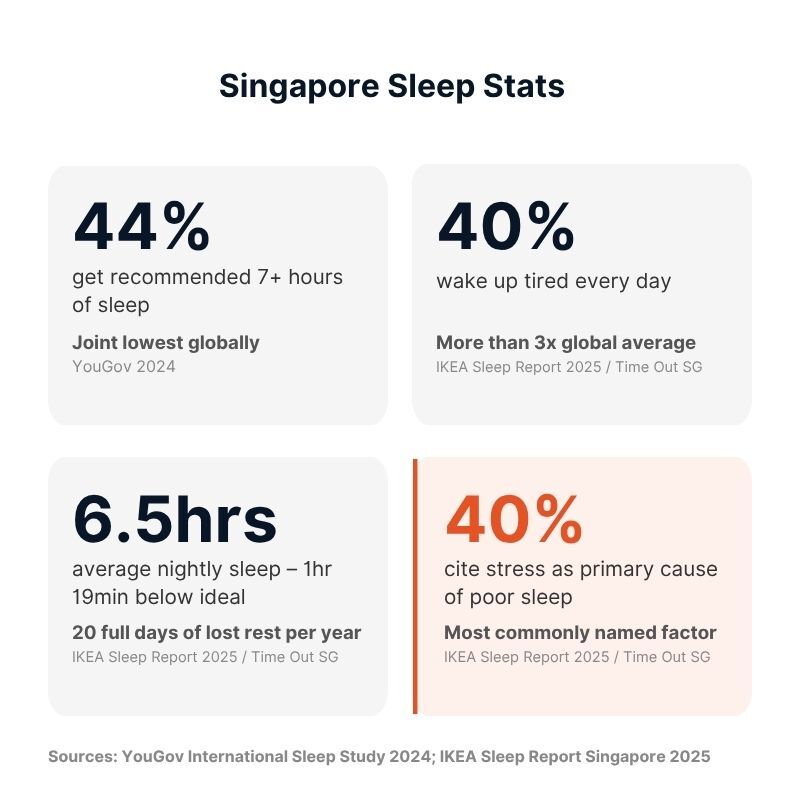
The cost
Beyond tiredness and next-day fuzziness, there’s another cost: the gradual depletion of biological resources that cannot be recovered in a single night. Sleep is the body's main window for repair and reset, the time when it does much of its overnight maintenance and prepares you for the day ahead. These are assets that build when the maintenance runs consistently, and erode when it doesn't. When sleep breaks down, the cost doesn't reset each morning. It accumulates.
The tired-but-wired problem has a name
Scientists call it cognitive hyperarousal – a state in which the brain's attention, threat-monitoring, and problem-solving systems stay switched on long after the body has run out of steam.
Sleep doesn't happen just because you're tired. It happens when the brain receives a coordinated set of signals that together communicate: it is now safe, dark, and appropriate to stop being vigilant.2 When those signals are disrupted, or when competing wake-promoting signals are too loud, sleep onset stalls, regardless of how exhausted you are.3,4
The frustrating truth is that exhaustion and sleep readiness are not the same thing. You can be depleted and wired simultaneously. In fact, chronic stress makes this more likely, not less.
The three biological reasons sleep won't come
1. Your stress system hasn't clocked off
Under normal conditions, cortisol – your primary stress hormone – follows a predictable daily rhythm. It peaks in the morning to help you wake and mobilize, and gradually declines through the day, reaching its lowest point in the early hours of sleep.5,6
Under chronic stress, this rhythm breaks down. Cortisol stays elevated into the evening, or spikes unexpectedly at night, keeping the body in a state of low-grade physiological alertness.6 The nervous system interprets this as: not yet safe to sleep.
This is why stressed people often report lying awake with no specific thoughts – just a vague, restless alertness they can't explain. Their bodies are following the stress hormone signal, not their conscious intention to sleep.
The same mechanism explains a very specific pattern many stressed people recognize: waking at 3am and being unable to get back to sleep. Cortisol begins its pre-dawn rise in the early hours of the morning as part of the body's natural preparation for waking. Under chronic stress, this rise can start earlier or spike more sharply than it should – pulling the nervous system out of sleep hours before it needs to be alert.6 The 3am awakening isn't a separate problem. It's the same stress hormone running its wake-up sequence at the wrong time.
High evening cortisol makes it harder to fall asleep, harder to stay asleep, and more likely you'll wake too early – even when you're doing everything else right.
This becomes self-reinforcing. Poor sleep pushes cortisol up, and elevated cortisol makes sleep harder still, a loop that can persist long after the original stressor has passed.6
The implication is important: no amount of screen-limiting or wind-down routines will fully overcome a dysregulated stress hormone rhythm.
READ: Why Your Cortisol Is Highest When You Most Need to Sleep
For a full breakdown of the cortisol-sleep mechanism – and what the evidence shows about recalibrating it.
2. Your brain is still in 'on' mode
Separate from stress hormones, the brain itself can stay busy in a way that blocks sleep. The parts you use to plan, analyze, and keep tabs on yourself, along with the ones that scan for problems and process emotion, can keep running when they should be winding down.
These systems are enormously useful during the day. But, at night, they become the enemy of sleep.
To fall asleep, the brain has to actively stand down. When the system responsible for quieting those circuits isn't strong enough, sleep stalls – no matter how exhausted you are.
This is the neurological basis of that familiar experience: lying in bed, physically still, but mentally running at full speed. The body has stopped, but the brain hasn't received the memo.
3. Your body clock has lost its signal
The third piece of the puzzle is circadian rhythm – your body's internal 24-hour timing system, governed primarily by light exposure and the hormone melatonin.
Here's what most people don't realize: many sleep difficulties aren't caused by a lack of melatonin at all. Melatonin governs the timing of sleep, and that timing can be disrupted – by evening light exposure or an irregular schedule – even when melatonin itself is being produced normally.7
When this happens, your circadian system and your chosen bedtime fall out of step. The body clock is timing sleep for one moment while you're trying to sleep at another, so the internal drive for sleep and your actual bedtime no longer line up.7,8
This is why people often find themselves lying awake at 11pm feeling neither fully alert nor fully sleepy – a kind of biological no-man's-land that makes falling asleep surprisingly difficult.
Why most sleep aids don't fix this
Understanding these three mechanisms also explains why conventional sleep aids so often disappoint.
Melatonin is a hormone the brain releases when darkness falls. It doesn't sedate you the way a sleeping pill does. Instead, it signals to the body that night has arrived, easing the transition into sleep rather than forcing it. That distinction matters, because it explains why simply taking more melatonin rarely solves a sleep problem driven by something else.
Melatonin is also available in supplement form. It is now one of the most widely used over-the-counter sleep supplements.9
Used correctly at low doses, it functions as a timing cue. The 3–10 mg in most supplements pushes blood melatonin far above the levels your body naturally produces,10 and at those doses some people report next-day grogginess, with drowsiness, headache, and dizziness among the most commonly noted side effects.11
Flooding the system with pharmacological doses can produce drowsiness – but it doesn't address stress-driven arousal or cognitive hyperarousal. It also risks disrupting the sensitivity of melatonin receptors over time, and the next-day grogginess can compound the very problem you're trying to solve.
Sedative herbal supplements – work mainly by dulling you into unconsciousness rather than by helping the underlying biology. They may get you to sleep faster, but sedation and natural sleep are not the same thing, and the rest it produces often leaves you feeling less restored than you would expect.
Sleep hygiene advice alone – such as dimming lights, avoiding screens, and keeping a consistent schedule, is a genuinely useful foundation. But habits can only go so far. When your body is under real, ongoing stress, good routines on their own often aren't enough, and the biology has to be supported directly too.
None of these approaches target all three mechanisms. Most target one, partially.
What actually helps
Sleep science increasingly points to the same idea: the support that lasts works with the systems your body already uses to fall asleep, rather than overriding them.
The Sleep Foundation, drawing on research from Harvard Medical School's Division of Sleep Medicine, notes that sleep is an active biological process – and what disrupts it is rarely just one thing.
The clinical evidence for each of the three mechanisms points toward specific approaches:
Addressing the stress hormone rhythm. Supporting the normal evening decline in cortisol so the nervous system can wind down. In a randomized controlled trial, adaptogens – plant compounds that help the body manage and recover from stress – such as Holy Basil, produced meaningful reductions in both perceived stress and measured cortisol levels in stressed adults.12
Supporting the 'stand down' signal. GABA is the nervous system's primary quieting compound – the signal that tells wake-promoting brain activity to stand down. In a human trial at the dose used here, daily GABA supplementation improved sleep efficiency and supported a shift toward parasympathetic ("rest") nervous system activity.13 Earlier work suggests it may also shorten the time to fall asleep.14
Reinforcing the body's sleep signal. Not with high doses of synthetic melatonin, but with plant-based melatonin at levels closer to the body's own natural output. In laboratory research using human cells, pistachio extract was found to contain natural melatonin alongside a second compound that appears to amplify melatonin's effect at its receptors.15 This work is at the cell level and hasn't yet been tested as a sleep outcome in people, but it points to why a plant-based source may behave differently from synthetic melatonin alone.
The goal, in each case, is not to force sleep – it's to remove what's preventing it.
Why Sleep On works differently
Most sleep supplements pick one pathway and push hard on it. High-dose melatonin addresses circadian timing but ignores cortisol. Sedative blends quieten the brain but don't touch the stress hormone rhythm. Nothing addresses all three.
Sleep On does. It is designed not to sedate, but to address the biological conditions that make sleep difficult in the first place: cortisol, cognitive arousal, and circadian timing.
Sleep On is built around recovery in the full biological sense. Not just helping you fall asleep, but protecting the conditions under which sleep actually restores. Each ingredient is selected for the specific barrier it removes, not for sedative potency.
Circadian cueing: Melostacio™ (plant-based melatonin from pistachio)
Sleep On uses 1mg of plant-based melatonin from pistachio via a standardized extract called Melostacio™, rather than the high synthetic doses found in most supplements. In laboratory research, using human cells, pistachio extract was found to contain natural melatonin alongside a second compound that appears to amplify melatonin's effect at its receptors.15 This work is at the cell level and has not yet been tested as a sleep outcome in people.
Stress modulation: Holixer® Holy Basil
Holixer is a clinically studied, standardized extract of Holy Basil (Ocimum tenuiflorum). In an 8-week double-blind, placebo-controlled trial in stressed adults, Holixer produced significantly greater reductions in perceived stress and sleep difficulties than placebo, alongside significantly lower hair cortisol concentrations at week 8, a marker of chronic stress hormone output. Sleep efficiency improved modestly over time, though without a significant difference between groups, and the researchers note that gold-standard sleep studies are needed to confirm the sleep effect.12 (The trial was funded by the ingredient's manufacturer.) It doesn't sedate. It removes the stress-driven wakefulness that keeps sleep at arm's length.
Neural quieting: GABA
GABA is the nervous system's primary quieting compound, the signal that tells wake-promoting brain activity to stand down. In a human trial at the dose used here, daily GABA supplementation improved sleep efficiency,13 and earlier work suggests it may shorten the time it takes to fall asleep.14
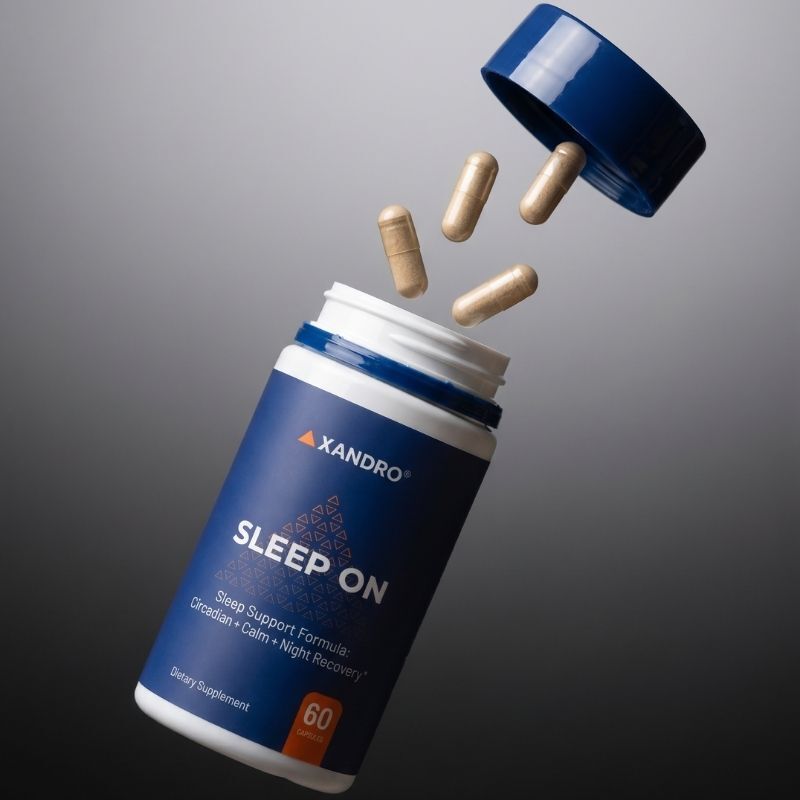
What makes Sleep On different?
Sleep On is non-sedative, non-habit forming, and designed for consistent nightly use without building tolerance or rebound wakefulness. No next-day grogginess, no blunting of the body's own melatonin production from high-dose supplementation, and no sedation that bypasses the sleep biology it should be supporting.
The bottom line
If you're exhausted but can't sleep, you're not broken. Your nervous system is doing exactly what chronic stress, disrupted circadian signals, and an overactive brain tell it to do: stay alert.
Sleep is not something you force. The solution isn't to hit it harder with sedatives or larger doses of melatonin. It's to address the three biological mechanisms that are keeping the wake switch on – and give your body the conditions it needs to do what it already knows how to do.
Sleep builds your Biocap. Ready to build your Biocap today?
Also in this series
→ Why Sleep Quality Matters More Than Sleep Duration – The Science of Non-REM Sleep
→ Is Melatonin Actually Working For You? What the Science Really Says
→ Why Your Cortisol Is Highest When You Most Need to Sleep
→ Magnesium Glycinate vs Ashwagandha vs Sleep On – Which Sleep Supplement Is Right for You?
Frequently Asked Questions
Why am I tired but can't sleep?
Being tired but unable to sleep, the 'tired but wired' state, usually comes down to three things happening at once: a stress hormone (cortisol) staying high into the evening, a brain that is still running in high gear (what researchers call cognitive hyperarousal), and a body clock that has drifted out of step with your bedtime. Any one of them can keep you alert long after your body has run out of energy.
What causes tired-but-wired syndrome?
The most common driver is chronic stress, which keeps cortisol elevated into the evening and maintains the brain in a state of low-grade vigilance. Contributing factors include irregular sleep schedules, evening screen use, high cognitive load, and anxiety. These aren't character flaws – they're the predictable output of modern life acting on a nervous system that evolved for very different conditions.
How do I fix tired but wired?
Behavioral approaches – consistent sleep timing, limiting screens before bed, reducing caffeine after midday – are a useful foundation, but have a ceiling when the nervous system is under sustained stress. Addressing the underlying biology directly tends to produce more reliable results: specifically, supporting the evening cortisol decline, quieting cognitive arousal, and restoring the body's circadian signal.
Is tired but wired the same as insomnia?
They overlap significantly but aren't identical. Insomnia is a clinical diagnosis characterized by difficulty initiating or maintaining sleep, with associated daytime impairment. Tired but wired describes a specific physiological pattern – stress-driven hyperarousal combined with a weakened circadian signal – that frequently underlies insomnia, but can also exist in people who don't meet the full clinical criteria. If your sleep difficulties are persistent or significantly affecting your daily functioning, it's worth speaking to a healthcare professional.
Can supplements help with tired but wired sleep?
Some can, as long as they target the right problem. High-dose melatonin and sedative botanicals do nothing for high evening cortisol or for a brain stuck in high gear, so they tend to fall short for tired-but-wired sleep. A better match for the underlying biology combines ingredients that support the evening fall in cortisol (such as clinically studied Holy Basil extracts), the brain's own calming signal (GABA), and a low, body-clock-friendly dose of melatonin.
How does sleep quality affect long-term health and performance?
Sleep is the main window in which the body catches up on its physical and mental work: repairing tissue, clearing waste from the brain, settling cortisol, and locking in memories. Poor sleep night after night does more than leave you tired the next day. A growing body of research links ongoing sleep disruption to faster biological aging, weaker thinking and focus, and a lower ability to cope with stress. Looking after your sleep is, in that sense, one of the highest-return investments you can make in your long-term health, which is part of why Sleep On is built to work on the root causes rather than mask them with sedation.
This product is a health supplement. It is not intended to diagnose, treat, cure, or prevent any disease. Always consult a qualified healthcare professional before starting any supplement, particularly if you are taking prescription medications, managing a health condition, or are pregnant or breastfeeding.
References
-
- Benjafield AV, et al. (2025). Estimation of the global prevalence and burden of insomnia: a systematic literature review-based analysis. Sleep Medicine Reviews. 82: 102121. PMID 40627924. DOI: 10.1016/j.smrv.2025.102121
- Borbély AA, Daan S, Wirz-Justice A, Deboer T. (2016). The two-process model of sleep regulation: a reappraisal. Journal of Sleep Research. 25(2): 131–143. PMID 26762182. DOI: 10.1111/jsr.12371 | Review / model (sleep-regulation framework).
- Saper CB, Fuller PM, Pedersen NP, Lu J, Scammell TE. (2010). Sleep state switching. Neuron. 68(6): 1023–1042. PMID 21172606. DOI: 10.1016/j.neuron.2010.11.032 | Review (sleep/wake switching circuitry).
- Riemann D, Spiegelhalder K, Feige B, Voderholzer U, Berger M, Perlis M, Nissen C. (2010). The hyperarousal model of insomnia: a review of the concept and its evidence. Sleep Medicine Reviews. 14(1): 19–31. PMID 19481481. DOI: 10.1016/j.smrv.2009.04.002 | Review (hyperarousal model).
- Yamanaka Y, Motoshima H, Uchida K. (2018). Hypothalamic-pituitary-adrenal axis differentially responses to morning and evening psychological stress in healthy subjects. Neuropsychopharmacology Reports. 39(1): 41–47. PMID 30480877. DOI: 10.1002/npr2.12042 | Human study (diurnal cortisol rhythm).
- Buckley TM, Schatzberg AF. (2005). On the interactions of the hypothalamic-pituitary-adrenal (HPA) axis and sleep. Journal of Clinical Endocrinology & Metabolism. 90(5): 3106–3114. PMID 15728214. DOI: 10.1210/jc.2004-1056
- Burgess HJ, Molina TA. (2014). Home lighting before usual bedtime impacts circadian timing: a field study. Photochemistry and Photobiology. 90(3): 723–726. PMID 24918238. DOI: 10.1111/php.12241
- Roenneberg T, et al. (2012). Social jetlag and obesity. Current Biology. 22(10): 939–943. PMID 22578422. DOI: 10.1016/j.cub.2012.03.038
- Li J, Somers VK, Xu H, Lopez-Jimenez F, Covassin N. (2022). Trends in Use of Melatonin Supplements Among US Adults, 1999–2018. JAMA. 327(5): 483–485. PMID 35103775. DOI: 10.1001/jama.2021.23652
- Claustrat B, Leston J. (2015). Melatonin: physiological effects in humans. Neurochirurgie. 61(2–3): 77–84. PMID 25908646. DOI: 10.1016/j.neuchi.2015.03.002
- Andersen LPH, Gögenur I, Rosenberg J, Reiter RJ. (2016). The safety of melatonin in humans. Clinical Drug Investigation. 36(3): 169–175. PMID 26692007. DOI: 10.1007/s40261-015-0368-5 | Review (adverse effects/safety of exogenous melatonin).
- Lopresti AL, et al. (2022). A randomized, double-blind, placebo-controlled trial investigating the effects of an Ocimum tenuiflorum (Holy Basil) extract (Holixer™) on stress, mood, and sleep in adults experiencing stress. Frontiers in Nutrition. 9: 965130. PMID 36185698. DOI: 10.3389/fnut.2022.965130 | Manufacturer-sponsored randomized controlled trial.
- Guimarães AP, et al. (2024). GABA Supplementation, Increased Heart-Rate Variability, Emotional Response, Sleep Efficiency and Reduced Depression in Sedentary Overweight Women Undergoing Physical Exercise: Placebo-Controlled, Randomized Clinical Trial. Journal of Dietary Supplements. 21(4): 512–526. PMID 38321713. DOI: 10.1080/19390211.2024.2308262
- Yamatsu A, et al. (2015). The improvement of sleep by oral intake of GABA and apocynum venetum leaf extract. Journal of Nutritional Science and Vitaminology. 61(2): 182–187. PMID 26052150. DOI: 10.3177/jnsv.61.182
- Labani N, et al. (2023). Pistacia vera Extract Potentiates the Effect of Melatonin on Human Melatonin MT1 and MT2 Receptors with Functional Selectivity. Pharmaceutics. 15(7): 1845. PMID 37514032. DOI: 10.3390/pharmaceutics15071845