
Protocol X vs NMN: Which One Improves NAD+ More?
7th Apr 2026
It's the question we get asked more than almost any other.
You know NAD+ matters. You know NMN can raise it. But if you're considering Protocol X® – a full-stack longevity formula with 20+ clinically evaluated ingredients – does it outperform a single-ingredient NMN capsule when it comes to actual NAD+ levels?
We decided to stop speculating. And start measuring.
Right now, we're in the middle of a 12-week pilot clinical study putting both head-to-head in real people – tracking NAD+ levels in blood, along with fatigue and cognitive performance. Here's exactly how it works.
Why This Question Is Worth Answering
NAD+ (nicotinamide adenine dinucleotide) is central to cellular energy production, DNA repair, and mitochondrial function. It declines with age – research shows this drop can range from 10 to 65% depending on tissue type and age.
That's why NMN has attracted serious research attention – human trials confirm it can raise blood NAD+ levels, though most studies are small, short-term, and vary widely in design.
What's far less understood is whether a comprehensive longevity protocol – one that combines NAD+ precursors with synergistic ingredients targeting cellular repair, mitochondrial function, and recovery – outperforms NMN alone. Single ingredient vs. full stack. That's the comparison no one has run. Until now.
How The Study Is Designed
This is a randomised, single-blinded, parallel-group pilot study in healthy adults aged 21–60.
Participants are assigned to one of two groups:
- 500 mg Pure NMN (capsule)
- Protocol X® (daily sachet)
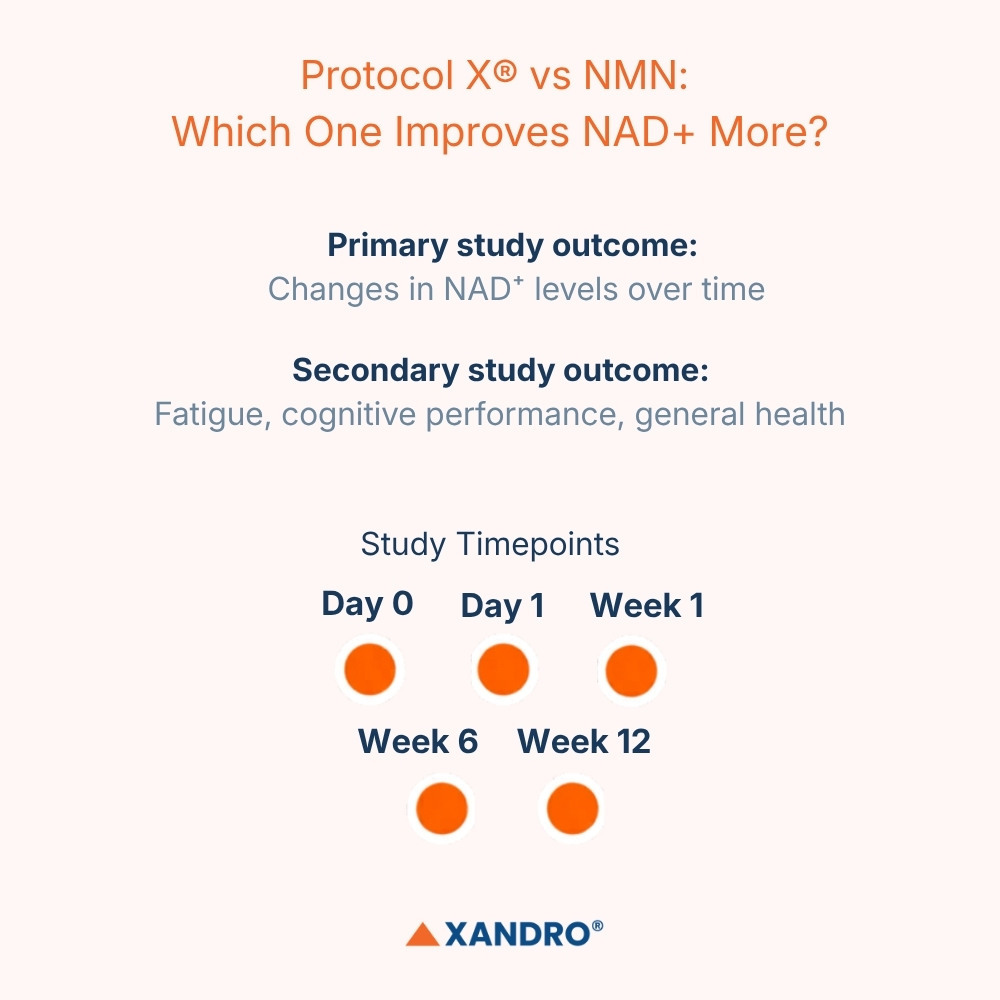
The study runs for 12 weeks, with structured check-ins at Day 0, Day 1, Week 1, Week 6, and Week 12. Blood samples are collected at each timepoint for NAD+ analysis. Participants maintain consistent lifestyle habits throughout and take their assigned supplement daily.
What we're measuring:
- Primary outcome: Changes in NAD+ levels over time
- Secondary outcomes: Fatigue (Fatigue Severity Scale), cognitive performance (Cognitive Failures Questionnaire), and general health (SF-12 survey)
Lab staff measuring NAD+ are blinded to group allocation throughout. Standardized statistical methods will be applied to all results. The protocol was built to produce data worth trusting.
Where We Are Today
As of this month:
- 17 active participants are enrolled
- We've completed baseline, early timepoints, and Week 6 blood collection
- Final (Week 12) blood draws begin 10 April
Week 12 is the most critical phase. Short-term changes at Day 1 and Week 1 are informative – but sustained, 12-week data is what tells us whether the effects are real, meaningful, and lasting.
What We'll Be Looking For

When the data is in, we'll be asking three questions.
- Which approach raises NAD+ more? And by how much? Do levels increase within each group? Is there a meaningful difference between Pure NMN and Protocol X®? How large is the effect at Week 12 versus earlier timepoints?
- Does the NAD+ change translate into how people actually feel? Reduced fatigue. Improved cognitive performance. And, critically, do those outcomes correlate with NAD+ changes? A biomarker shift that doesn't translate into real-world function is only half the story.
- Who responds, and why? Biology isn't uniform. We'll look at whether baseline NAD+ levels or lifestyle factors predict response – because understanding variability is as valuable as understanding averages.

What This Study Is. And Isn't.
This is a pilot study, not a definitive clinical trial. Smaller sample size, designed to detect signals rather than draw final conclusions.
But it directly addresses a question that existing research hasn't answered: does a full-stack NAD+ protocol – with ingredients working across multiple longevity pathways – produce meaningfully different outcomes compared to a single precursor alone?
Even as a pilot, the findings will validate or challenge a core assumption behind how we formulate Protocol X®. If Pure NMN alone performs identically, that's important data. If Protocol X® shows a meaningful advantage – in NAD+ levels, fatigue, or cognitive performance – that's equally important.
We'll share what we find. Good or bad.
What Comes Next
Final blood draws begin 10 April. Data analysis follows immediately. Results will be published here, transparently – with full context on what the findings mean and what they don't.
If the signal is strong, this won't be the end. It will be the starting point for a larger, more definitive trial.
Complex science. Simple routine. Yes to more life.
Ready to start your NAD+ protocol now?
Explore Pure NMN and Protocol X at xandrolab.com.
Interested in NAD⁺, our products and our research?
Explore our truly informative blog:
Best NMN Supplements in Singapore 2026 + How to Choose
The Science Behind Longevity: Key Ingredients in Our New Supplement
AG1 or Protocol X® V3: Which Daily Supplement Should You Choose?
Andrew Huberman's Longevity Supplement Stack (2026)
References
- Imai S, Guarente L. NAD+ and Sirtuins in Aging and Disease. Trends in Cell Biology. 2014. DOI: 10.1016/j.tcb.2014.04.002
- Covarrubias AJ, et al. NAD+ metabolism and its roles in cellular processes during ageing. Nature Reviews Molecular Cell Biology. 2021. DOI: 10.1038/s41580-020-00313-x
- Huang H, et al. The efficacy and safety of β-NMN supplementation in healthy middle-aged adults: a randomized, multicenter, double-blind, placebo-controlled, parallel-group, dose-dependent clinical trial. GeroScience. 2022. DOI: 10.1007/s11357-022-00705-1
- Okabe K, et al. Oral Administration of NMN Is Safe and Efficiently Increases Blood NAD+ Levels in Healthy Subjects. Frontiers in Nutrition. 2022. DOI: 10.3389/fnut.2022.868640