
Still Tired After 8 Hours? The Science of Deep Sleep Quality vs Duration
8th Jun 2026
Why Sleep Quality Matters More Than Sleep Duration – The Science of Non-REM Sleep
Eight hours in bed. Still exhausted in the morning. Sound familiar?
Sleep duration gets almost all the attention. But increasingly, sleep science tells us that how long you sleep is only part of the picture. What matters just as much, and possibly more, is the internal architecture of your sleep: specifically, whether you're spending enough time in the deep, restorative stages that drive physical and cognitive recovery.

Sleep isn't one thing – it's a sequence
Every night, your brain cycles through a predictable series of stages, repeating four to five times across the night. Each cycle lasts roughly 90 minutes and includes both non-REM (NREM) and REM sleep.
As Harvard Health explains, non-REM sleep involves three stages, progressing from light sleep into increasingly deep sleep. It's the deepest stage, known as slow-wave or stage N3 sleep, that sleep specialists consider the primary time when the body renews and repairs itself.
REM sleep, which dominates the later part of the night, is where most dreaming occurs and where the brain consolidates memories, processes emotional experiences, and restores cognitive function.
The composition of your sleep, not just its length, appears to matter for long-term brain health. In a Framingham Heart Study analysis that tracked 321 older adults for up to 19 years, each 1% reduction in REM sleep was associated with roughly a 9% higher risk of developing dementia; in this particular study, stages of deep non-REM sleep were not linked to dementia risk. (Pase et al., 2017)
Both REM and deep non-REM do distinct restorative work, and the broader point holds: what your sleep is made of matters, not just how many hours you spend in bed.
Both stages are essential. But they can only deliver their benefits if you actually reach them – and stay in them.
What happens during deep non-REM sleep
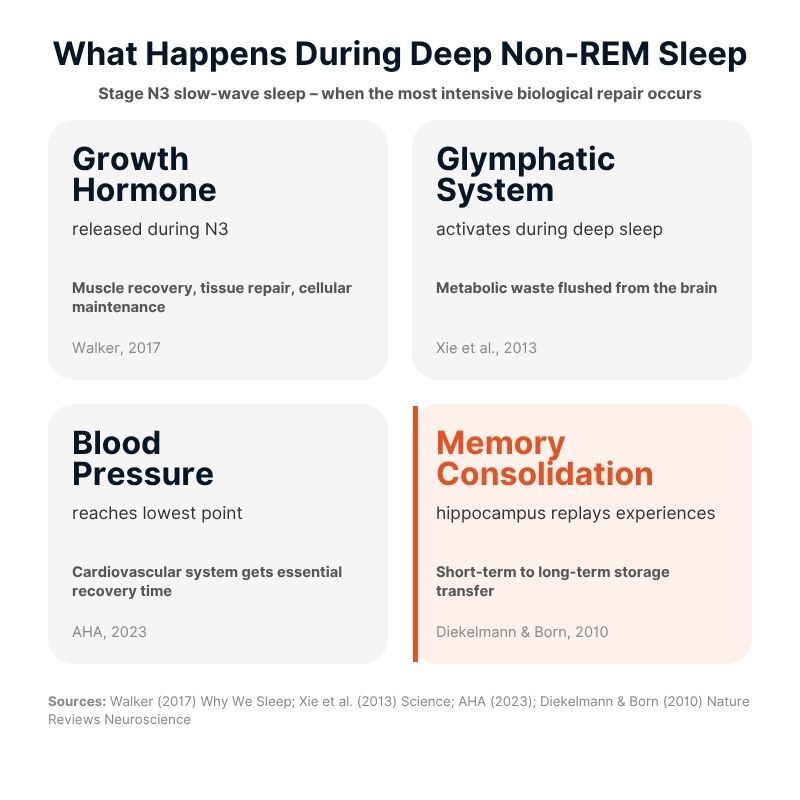
Stage N3 – deep slow-wave sleep – is where the most intensive biological repair work takes place. During this stage:
- Growth hormone is released, driving muscle recovery, tissue repair, and cellular maintenance.
- Cellular energy is restored. Deep sleep is the stage most closely linked to replenishing ATP – the molecule that powers every biological process, from muscle contractions to brain function. (Harvard Health, n.d.-a)
- The glymphatic system, the brain's own waste disposal network, flushes out byproducts that build up during waking hours – including proteins associated with Alzheimer's disease. This process is far more active during deep sleep than at any other time. (Harvard Health, n.d.-b; Sleep Foundation, n.d.)
- Blood pressure reaches its lowest point, giving the cardiovascular system essential recovery time.
- The immune system gets a significant boost, supporting the body's ability to fight infection and inflammation.
- Memory consolidation begins. The brain sorts and stores the day's experiences, moving them from short-term into long-term memory.
When deep sleep is disrupted or insufficient, none of these processes can complete properly – even if total sleep time looks normal on a tracker.
The problem with fragmented sleep
Fragmented sleep – sleeping lightly, waking frequently, or cycling through only the earlier stages – is one of the most common and underrecognized sleep problems. People who experience it often report sleeping 'all night' but waking tired, foggy, or emotionally flat.
The Sleep Foundation, drawing on Harvard Medical School research, notes that deep non-REM sleep is concentrated in the first half of the night. Waking early, whether from stress or disruption, means losing the most restorative part of your sleep first. (Sleep Foundation, n.d.)
In Singapore, this pattern is well documented. Researchers at the NUS Sleep and Cognition Lab have found that even short periods of restricted sleep measurably impair vigilance and working memory. These are not minor inconveniences. Over time, they compound.
The effects aren't just felt in how you perform the next day. They accumulate in the body. The repair work that deep sleep does – clearing waste from the brain, rebuilding cells, consolidating memory, supporting immune function – cannot be deferred to the following night. Each night of insufficient deep sleep leaves those systems a little further behind. The deficit is biological, not just a matter of how tired you feel.
What disrupts deep sleep
Several factors specifically suppress or fragment deep non-REM sleep:
Stress and elevated cortisol
Cortisol and deep sleep are biologically incompatible. When cortisol stays elevated in the evening, the nervous system can't fully stand down. Deep sleep needs exactly that stillness. This is why stressed people often feel unrested even after a full night. They may be sleeping, but not deeply.
Sedative sleep aids
Counterintuitively, some sedative approaches – including certain antihistamines, benzodiazepines, and high-dose melatonin – can suppress deep non-REM sleep while increasing lighter sleep stages. Sleep induced this way may feel adequate but lacks the restorative architecture of natural sleep.
Alcohol
A common 'sleep aid' that reliably suppresses REM sleep in the second half of the night, leaving users feeling flat and unrefreshed despite having slept.
Irregular sleep schedules
Deep sleep isn't available on demand. The circadian system determines when conditions are right for it, typically in the earlier part of the night. Irregular schedules disrupt that window, reducing both the amount and quality of deep sleep.
This misalignment has a name in sleep science: social jet lag. The term was coined by sleep researcher Till Roenneberg and describes the gap between your biological clock and your social schedule. The most common form: sleeping and waking significantly later on weekends than on weekdays (Roenneberg et al., 2012).
Research published in Current Biology found that this shift is measurable and associated with higher BMI, regardless of total sleep hours. The problem isn't the extra sleep on the weekend. It's the clock reset that follows, making Monday feel like the first day of jet lag, every week (Roenneberg et al., 2012).
The secret to deep, restorative sleep:
Work with sleep architecture rather than bypassing it
What supports deep, restorative sleep
The goal isn't to force deep sleep – it's to create the conditions in which the brain can move through its natural architecture undisturbed.
Support the stress hormone rhythm.
Supporting the normal evening decline in cortisol is one of the most direct ways to protect deep sleep. In a manufacturer-sponsored randomized controlled trial, Holy Basil (Ocimum tenuiflorum) was associated with reductions in cortisol and in self-reported sleep difficulty in stressed adults, without sedation (Lopresti et al., 2022).
Quiet the brain's alerting system.
GABA is the nervous system's primary quieting compound – the signal that tells wake-promoting brain activity to stand down. In clinical research, oral GABA supplementation has been shown to shorten the time to fall asleep and increase total non-REM sleep time (Yamatsu et al., 2016).
Reinforce the body's sleep signal.
Melatonin at low doses – closer to the body's own natural output than the amounts found in most supplements – supports the body clock's timing of deep sleep without disrupting sleep architecture. The dose matters as much as the compound.
Keep a consistent schedule.
Going to bed and waking at the same time daily is one of the most powerful, evidence-based ways to protect sleep architecture over time. Consistency also reduces the social jet lag effect, keeping the biological and social clocks aligned so deep sleep becomes available at the right time.
The common thread across all of these is that they work with sleep architecture rather than bypassing it. Deep, restorative sleep cannot be manufactured. It emerges when the biological conditions allow it. Creating those conditions consistently is important. What that consistency builds across months and years cannot be recovered in a single good night. And it won't appear on a sleep tracker.
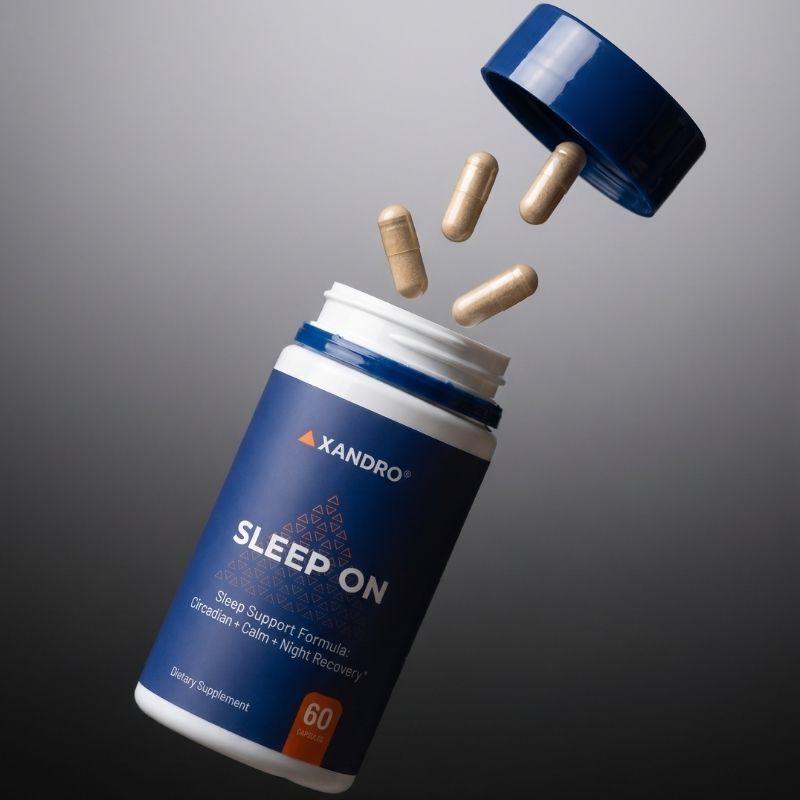
Sleep On – designed around sleep architecture, not sedation. Most sleep supplements work against the biology described in this article. Sedative formulas suppress deep non-REM sleep rather than protect it. High-dose melatonin distorts sleep architecture rather than supporting the body's natural timing. Neither addresses cortisol – the primary hormonal barrier to deep sleep.
Sleep On was formulated around the three mechanisms the science points to.
Holixer® Holy Basil for the evening cortisol decline that deep sleep depends on. GABA for the neural quieting that allows the brain to transition into and maintain slow-wave sleep. Melostacio™ – 1mg plant-based melatonin from pistachio – to reinforce the circadian signal that schedules deep sleep at the right time of night, without the doses that suppress it (Labani et al., 2023).
The goal is not to knock you out. It is to create the conditions in which deep sleep can run its full course – the clearance, the repair, the consolidation – undisturbed.
The bottom line
Eight hours of light, fragmented sleep is not the same as six hours of deep, well-structured sleep. The number on your tracker doesn't tell you whether you spent enough time in the stages that actually restore you.
If you're waking unrefreshed despite adequate time in bed, the question to ask isn't 'how do I sleep longer?' It's 'what's preventing me from sleeping deeply?'
That question matters beyond tomorrow morning. The biological maintenance that deep sleep enables – the clearance, the repair, the consolidation – represents the body's primary recovery window. What you protect there, consistently and over time, does not reset each day. It compounds.
Also in this series
→ Read our anchor post on the three biological reasons you can't switch off – and why most sleep aids fall short. [LINK: /blogs/tired-but-wired-cant-sleep]
→ Read Is Melatonin Actually Working For You? What the Science Really Says [LINK: /blog/does-melatonin-work-what-science-says]
→ Read about why your cortisol is highest when you most need to sleep – and what the evidence says about recalibrating it. [LINK: /blogs/cortisol-high-at-night-sleep]
This product is a health supplement. It is not intended to diagnose, treat, cure, or prevent any disease. Always consult a qualified healthcare professional before starting any supplement, particularly if you are taking prescription medications, managing a health condition, or are pregnant or breastfeeding.
References
Harvard Health. (n.d.-a). How Sleep Boosts Your Energy. https://www.health.harvard.edu/healthbeat/how-sleep-boosts-your-energy [Secondary source – consumer health publication].
Harvard Health. (n.d.-b). Sleep and Brain Health: What’s the Connection? https://www.health.harvard.edu/heart-health/sleep-and-brain-health-whats-the-connection [Secondary source – consumer health publication].
Labani N, et al. (2023). Pistacia vera Extract Potentiates the Effect of Melatonin on Human Melatonin MT1 and MT2 Receptors with Functional Selectivity. Pharmaceutics. 15(7): 1845. PMID 37514032. DOI: 10.3390/pharmaceutics15071845
Lopresti AL, et al. (2022). A randomized, double-blind, placebo-controlled trial investigating the effects of an Ocimum tenuiflorum (Holy Basil) extract (Holixer™) on stress, mood, and sleep in adults experiencing stress. Frontiers in Nutrition. 9: 965130. PMID 36185698. DOI: 10.3389/fnut.2022.965130 | Manufacturer-sponsored randomized controlled trial.
Pase MP, et al. (2017). Sleep architecture and the risk of incident dementia in the community. Neurology. 89(12): 1244–1250. PMID 28835407. DOI: 10.1212/WNL.0000000000004373
Roenneberg T, et al. (2012). Social jetlag and obesity. Current Biology. 22(10): 939–943. PMID 22578422. DOI: 10.1016/j.cub.2012.03.038
Sleep Foundation. (n.d.). What Happens When You Sleep. https://www.sleepfoundation.org/how-sleep-works/what-happens-when-you-sleep [Secondary source – sleep health organization].
Yamatsu A, et al. (2015). The improvement of sleep by oral intake of GABA and apocynum venetum leaf extract. Journal of Nutritional Science and Vitaminology. 61(2): 182–187. PMID 26052150. DOI: 10.3177/jnsv.61.182
Yamatsu A, et al. (2016). Effect of oral gamma-aminobutyric acid (GABA) administration on sleep and its absorption in humans. Food Science and Biotechnology. 25(2): 547–551. PMID 30263304. DOI: 10.1007/s10068-016-0076-9